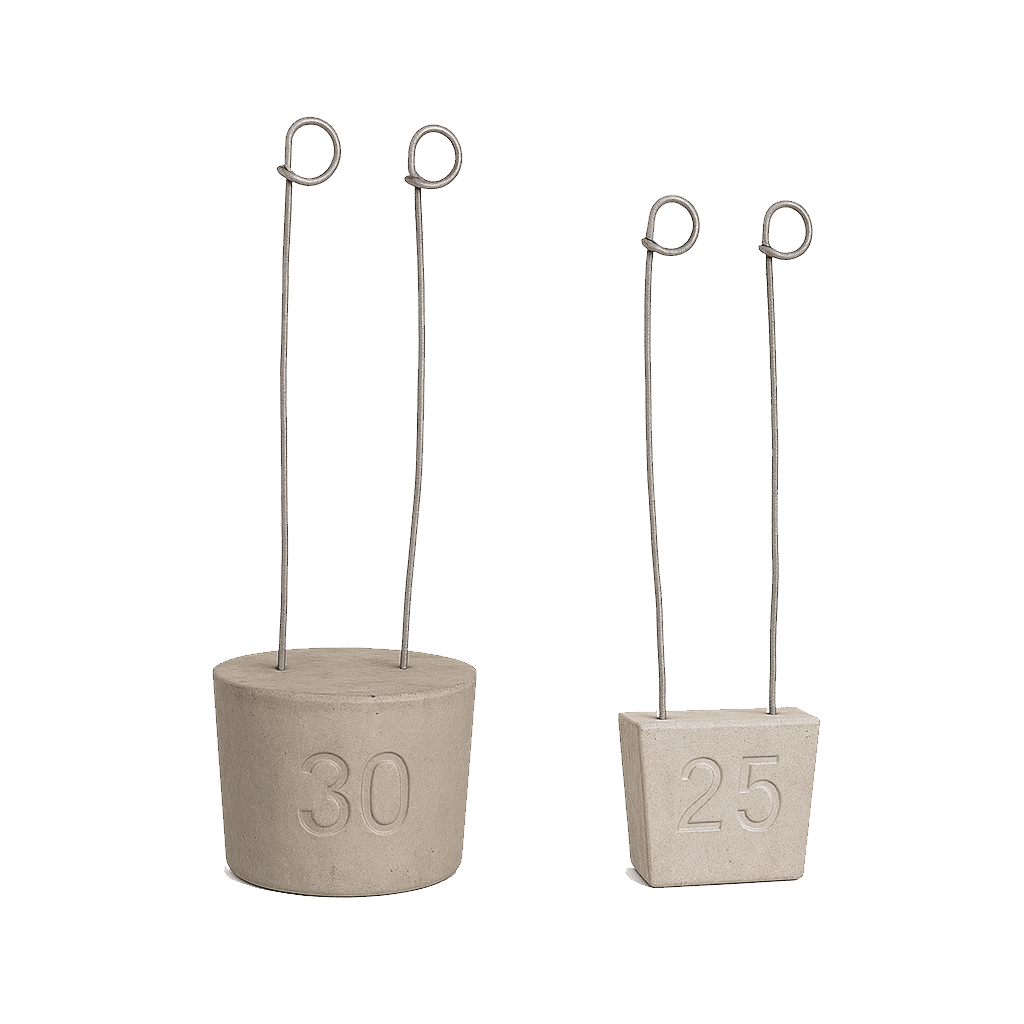
Concrete Bar Chairs
PROMAXA Concrete Spacers are ideal for slab on-ground and wall applications, for steel reinforcing in major civil and infrastructure projects. They have high load capacity and are heat tolerant in the event of a fire. The wider flat- based spacer has rust-resistant tie wire ensuring a stable concrete bar chair, reducing rolling, and tilting when being installed. The uniquely tapered design provides interlock within the structure, preventing fallout.
Features:
- Galvanised-looped tie wire
- Size imprinted on side of spacer for easy Identification
- Tapered design for ultimate interlock

This calculator sizes reinforcement bar chairs for the construction stage. It works out the load each chair carries from the self-weight of the supported reinforcement plus a construction live load, then returns the maximum chair spacing and the number of chairs per square metre so that the serviceability load on each chair stays at or below its AS/NZS 2425:2015 rated grade.
How to use it:
- Choose the application (sets the 800 mm / 600 mm spacing cap).
- Select the supported reinforcement - mesh grade and layers, or bar size, spacing and arrangement.
- Pick the construction live load basis (or enter a custom value).
- Select the chair strength grade.
The lookup tables below convert your selections into the mass, live load and rated capacity used by the calculation. Each calculation step then shows its full expression and the working, so the method is transparent. The check is serviceability (1.0G + 1.0Q) against the rated grade, as recommended for AS/NZS 2425 chairs because the rated-load test embeds no overload factor. A factored 1.2G + 1.5Q value (AS/NZS 1170.0) is also shown for information.
Notes and limitations:
- Design basis. AS/NZS 2425:2015 rates chairs in kilograms (60 / 120 / 200 / >300 kg) verified by a short-term load test with no overload factor. The rated load is treated here as a characteristic serviceability capacity; the governing check is the SLS demand (1.0G + 1.0Q) against the rated grade. The ULS figure (1.2G + 1.5Q) is informational only.
- Construction live load is a convention, not a code value. The default 1.5 kPa originates from The Structural World worked example (1 Aug 2018). No Australian standard mandates it. EN 1991-1-6 (1.0 kPa) and ASCE 37-14 (0.96 / 1.20 / 2.40 / 3.60 kPa) are offered as alternatives.
- Spacing caps override the load result. Maximum spacing is the lesser of the load-governed value and the cap: ≤800 mm general (SRIA TN3; ABCB Housing Provisions 4.2.11(7)(e)) or ≤600 mm residential pavements (AS 3727.1 Cl. 5.4(e)). Place the perimeter row ≤500 mm from formwork edges and a chair at every cantilever tip.
- Check the load per chair. The reported load per chair at the governing spacing must not exceed the rated capacity. If it does, choose a higher grade or reduce the spacing.
- Base plates for on-ground chairs. For footings, slab-on-ground and pavements the chairs bear on the ground and need a base plate so they do not sink in. The calculator works out the required bearing area from the load per chair and the allowable ground bearing pressure you enter (guide: ~300 kPa on sand, ~500 kPa on a damp-proof membrane over sand), then recommends the smallest Promaxa round base plate (PBP152 = 152 mm or PBP224 = 224 mm) whose area covers it. If the result is 0, even the 224 mm plate is too small - reduce the spacing, use a higher chair grade, or improve the ground bearing. Suspended slabs are cast on formwork and do not need a base plate. The bearing pressure is a project-specific judgement - no Australian standard prescribes it.
- Material / exposure not screened here. This version computes load, spacing and base-plate size only. It does not screen chair material against exposure class or bridge specifications (e.g. Main Roads WA Spec 822 Cl. 822.29, TfNSW B80 Cl. 6.2, VicRoads 703.13), which ban plastic and/or wire chairs on many structures. Confirm the permitted chair material separately.
- Out of scope: plastic-chair temperature derating above 30 C; wire-chair slenderness (Euler) derating for tall chairs; bespoke hurdles (>300 mm), which are a buckling/ULS design; and continuous deck-rail spacers, which need a separate linear-capacity check.